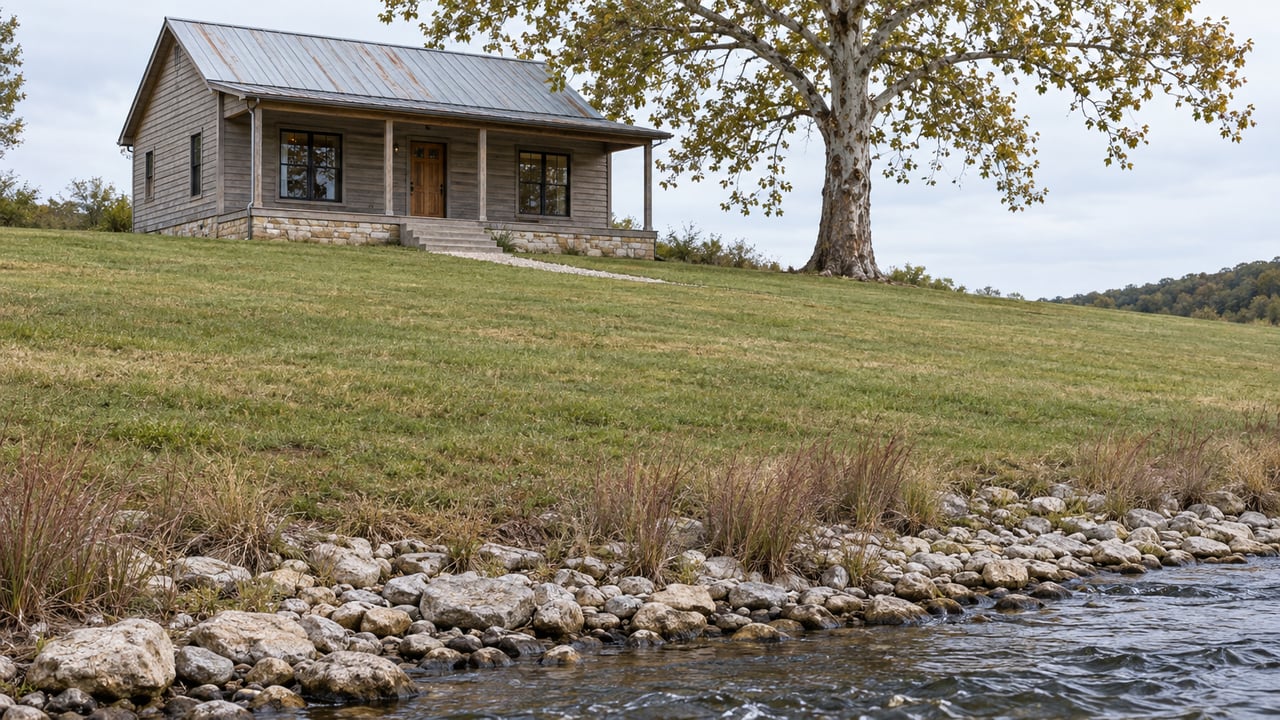
Norfork AR White River Frontage Land for Sale: What Frontage Means
October 1, 2026
October 1, 2026
Search White River land in Norfork this fall and two listings will likely turn up within scrolling distance of each other. One is a little under an acre in a subdivision with underground utilities already in the ground and a boat launch a short walk from the lot line. The other is close to four acres of raw ground with a line near the bottom of the description: it will need a well and septic. Both list under the same phrase: White River frontage. The price gap between them has almost nothing to do with the river.
Frontage tells you where the property touches water. It does not tell you what still has to be dug, drilled, permitted, and paid for before that property can hold a house. In Norfork right now, that second question is where the real money sits, and it splits the market into products that share a description but not much else.
Pull up enough Norfork river land and a pattern shows up fast. The listings sort into three rough tiers, and the tier matters more than the acreage.
The first tier is raw, unrestricted acreage. These lots often sit on a paved county road with electric running to the property line and nothing else. Several current listings say it outright: the lot will need a well and septic before anyone builds. That phrasing is doing real work. It means the buyer, not a developer, absorbs the cost and timeline of bringing water and wastewater treatment to the site.
The second tier is the established river subdivision. Stone Creek Subdivision is the clearest example on the market right now, with lots close to a full acre, roughly 125 feet of river frontage, underground utilities already installed, and a community boat launch with nearby parking. Other river subdivisions in town follow a similar pattern: private boat launch, underground electric, a shared common area, and covenants that keep the neighborhood looking a certain way. The infrastructure cost has already been paid by whoever platted the subdivision, and it is baked into the lot price instead of waiting for the buyer after closing.
The third tier is the newest one. Rail & River Reserve is being marketed as Norfork's newest river subdivision, with lots starting at $49,900 and city water, electric, and fiber internet already run, positioned just blocks from the downtown Commercial District. It is not always directly on the riverbank the way a Stone Creek lot is. What it sells instead is full municipal infrastructure at a lower entry price than the acreage tier often carries once you add drilling and permitting costs back in.
| Raw Acreage | Established Subdivision (Stone Creek type) | New In-Town Lots (Rail & River Reserve) | |
|---|---|---|---|
| Utilities | Electric at road only; well and septic needed | Underground electric, utilities in place | City water, electric, fiber internet |
| Water access | Direct river frontage, condition varies | Direct frontage plus shared or private boat launch | Walking distance to downtown, not always direct frontage |
| What you still pay for | Well, septic design and permit, possibly a perc test | Little beyond the lot itself | Little beyond the lot itself |
| Covenants | Often none, marketed as "unrestricted" | Yes, subdivision restrictions apply | Yes, subdivision restrictions apply |
The raw-acreage tier looks cheaper per acre until you price in what "will need well and septic" actually costs in Arkansas.
Drilling a private well typically runs $4,000 to $12,000 or more, and the process itself has steps that take time even after a buyer is ready to build. DrillerDB's Arkansas well guide says a $145 rig permit from the Arkansas Natural Resources Commission is required before drilling. A driller evaluates the site, then drills and cases the well over one to three days.
Septic is its own process, run through the county Health Unit and, for larger systems, the Arkansas Department of Environmental Quality. A soil evaluation determines whether the ground can support a standard system or needs a more expensive alternate design. One detail matters a lot for the acreage tier specifically: The Arkansas Department of Health says Arkansas exempts a single residence on ten acres or more from needing a septic permit, as long as every part of the system stays more than 200 feet from any property line, including roads. That exemption only covers the permit requirement itself, but it explains why some of the larger raw parcels near Norfork market themselves as simpler to build on than a two- or three-acre lot with the same "will need well and septic" language.
A completed percolation test shows up as a selling point on some raw listings and is absent from others. That single line item is worth asking about directly, because a perc test that has not been run yet is a soil evaluation the buyer inherits, along with the risk that the ground doesn't pass on the first try.
A few phrases on a Norfork land listing are doing more work than they look like they're doing.
None of this makes one tier better than another. A buyer who wants a private well and total control over the site is choosing the raw-acreage tier on purpose. A buyer who wants to be in the water this season is better served paying more per acre for a lot where Stone Creek's utilities and boat launch are already sitting there. The point is knowing which product a listing price is describing before making an offer on it.
Rail & River Reserve is worth watching specifically because of where it sits in this pricing structure. A $49,900 entry point with city water, electric, and fiber internet already run undercuts what a buyer would spend piecing together a well and septic system on a comparable raw lot, even before counting the time those permits and inspections take. It also sits close enough to Norfork's downtown Commercial District that the appeal isn't only the river. It's proximity to town with full services, a different pitch than the gravel-bar-and-privacy pitch that raw acreage makes.
That combination, a new in-town subdivision competing on infrastructure rather than on riverbank footage, is a sign the Norfork land market is starting to serve buyers who want the convenience tier without needing the highest per-foot price a direct Stone Creek-style lot commands.
If a lot has a completed perc test, can I start building right away? A perc test only measures how well the soil absorbs water, not the full septic design review. A completed perc test removes one risk and one delay, not the entire approval process.
Does the ten-acre septic exemption mean I can skip a permit entirely? The exemption applies to a single residence on ten acres or more where every part of the sewage system stays more than 200 feet from any property line, including roads. It removes the requirement to obtain a permit specifically. It's a real advantage on the right-sized raw lot, but it depends on where the house and system actually sit relative to the property boundaries.
Does "unrestricted" mean the lot already has utilities? No. "Unrestricted" almost always refers to the absence of subdivision covenants and building restrictions, not to whether water, sewer, or electric infrastructure is already in place. An unrestricted lot can still be the raw-acreage tier that needs a well and septic from scratch.
If you're comparing river lots in Norfork and want help reading what a specific listing's language actually means for your budget and timeline, Home With the Hoffmanns can walk through the tier, the utilities, and the real cost to build before you write an offer.
This article is general information, not legal, tax or financial advice. Consult a qualified professional about your situation.
Stay up to date on the latest real estate trends.

We are a full-service team that provides a clear, stress-free process for every client. We offer specialized support for first-time homebuyers and sophisticated, strategic marketing for luxury clients, turning complex transactions into certain success.

[email protected]
(870) 404-9373
[email protected]
(870) 656-2218
707 N Cardinal Dr Ste 4
Mountain Home, AR 72654