Lakeview Has Two Waterfronts, And They Don't Behave The Same Way
September 17, 2026
September 17, 2026
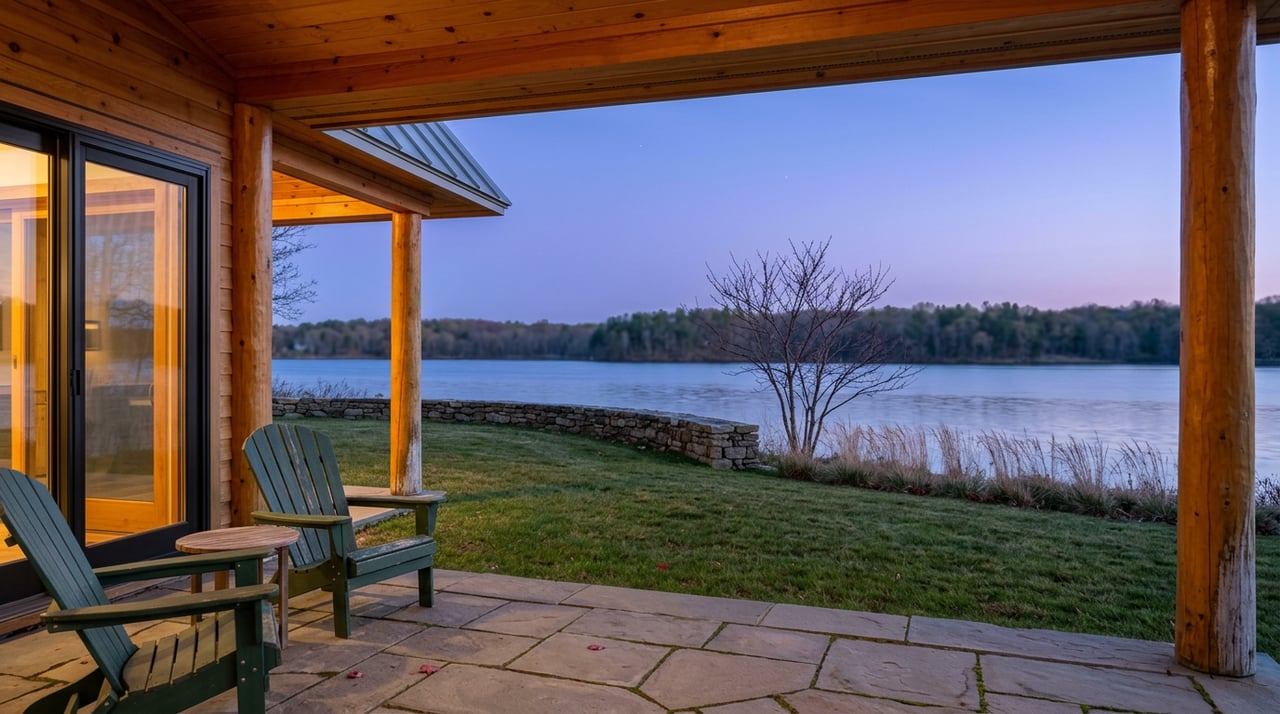
Search "waterfront" in Lakeview, Arkansas and the results treat every listing like it belongs to the same body of water. It doesn't. Lakeview sits on a strip of land pinched between Bull Shoals Lake on one side and the White River on the other, and the thing that separates them isn't just geography. It's Bull Shoals Dam, and the dam changes what "waterfront" actually means depending on which side of it your property sits.
That distinction matters more than square footage, more than the listing photos, and more than the word "lakefront" printed at the top of the page. One side is a managed reservoir with predictable water levels and a built-out marina economy. The other is a working tailwater whose levels rise and fall on a schedule set by hydropower demand, not by nature. Buyers who treat the two as interchangeable end up surprised, usually after they've already made an offer.
Bull Shoals Dam was completed in 1951 to control flooding on the White River and generate hydroelectric power, and at the time of its construction it ranked among the largest concrete dams in the country. The towns of Lakeview and Bull Shoals grew up on either side of the gorge where it was built, originally to house the workers who spent years constructing it. Once finished, the dam backed up the river valley into what is now a 45,150-acre lake managed by the U.S. Army Corps of Engineers, while the river below continued on as the White River tailwater.
That single piece of infrastructure created two economies out of one town. Above the dam, you get a warm-water reservoir with bass, crappie, walleye, and no shortage of marinas and swim beaches. Below it, you get a cold-water trout fishery that draws anglers from well outside Arkansas. Both are real. Both show up in local listings tagged "waterfront." They are not the same product, and the dam is the reason why.
This is the part that catches people off guard. The White River below Bull Shoals Dam stays at a nearly constant 52 degrees year round because it's fed by water released from deep in the reservoir, and that constant temperature is exactly why it produces browns pushing past 30 pounds and rainbows near 20. There's no closed season. You can fish it any day of the year.
But the same mechanism that keeps the water cold also keeps it unpredictable. The dam releases water on a schedule tied to power generation, not to what's convenient for the person who owns the dock. The City of Lakeview's own community information notes that water levels on the White River change often because of the dam's operating schedule, and that they can rise quickly enough to become hazardous for anglers and boaters who aren't paying attention.
That's not a footnote. It's the reason river-frontage listings in this area tend to look different from lake listings. Rather than move-in-ready homes with a fixed dock, you'll more often see raw acreage marketed toward builders and investors. One property currently listed through ERA Doty is a 2.57-acre parcel with roughly 341 feet of White River frontage, positioned for a custom home or a small river community rather than sold as a finished house. That's not a coincidence. When water levels move on a hydropower schedule instead of a seasonal one, permanent dock infrastructure gets harder to plan around, and land tends to trade as a building opportunity instead of a turnkey purchase.
If your picture of lake living involves walking down to a fixed dock every evening, that picture belongs to the other side of the dam.
Bull Shoals Lake itself is more forgiving. Because it's a managed reservoir, the Corps of Engineers holds it at conservation pool levels for most of the recreational season, which means the swings a river-frontage buyer has to plan for mostly don't apply here. The lake supports year-round fishing with no closed season, hundreds of miles of shoreline, and a marina infrastructure that includes Lakeview Cove Marina, just minutes from the dam.
Even within the lake side, though, price isn't flat. Listings for Bull Shoals Lake homes typically show a real spread by frontage type. Channel-front properties, meaning homes on a narrower inlet off the main body of water, tend to run from around $60,000 up toward $200,000. Main-lake frontage, with open water access and better boat clearance, regularly runs from $200,000 into seven figures depending on condition and location. That spread isn't about square footage. It's about how close a property sits to open, navigable water and how much boat traffic can reach it directly.
Here's a side-by-side of what separates the two sides of the dam:
| Above the Dam (Bull Shoals Lake) | Below the Dam (White River) | |
|---|---|---|
| Water behavior | Managed reservoir, Corps-controlled conservation pool | Tailwater, levels shift with hydropower releases |
| Typical fishery | Bass, crappie, walleye, no closed season | Trout, constant 52°F, no closed season |
| Common listing type | Finished homes and cabins, channel or main-lake frontage | Raw acreage and buildable lots, often builder-marketed |
| Rough price band | Roughly $60K (channel front) to $200K+ (main lake) | Priced by acreage and frontage footage, varies widely |
| Anchor landmarks | Lakeview Cove Marina, Bull Shoals-White River State Park | Bull Shoals-White River State Park, Gaston's White River Resort |
Since Lakeview physically wraps around both bodies of water, the address alone won't tell you which market you're looking at. The landmarks will.
Bull Shoals-White River State Park sits right where the lake meets the river below the dam, and its visitor center, the James A. Gaston Visitor's Center, overlooks the dam itself. If a listing describes proximity to the park's river side, campgrounds, or the Trout Dock, you're looking at tailwater property and should be asking about dock feasibility given fluctuating levels, not assuming one comes standard.
Gaston's White River Resort, in Lakeview since 1958 and still run by the Gaston family, sits on the river side and has built its entire business around the constant cold water and trophy trout, which tells you something about how that stretch of shoreline actually gets used day to day. It's a fishing destination first.
On the lake side, references to Lakeview Cove Marina, swim beaches, or channel access point you toward the reservoir market, where conservation-pool management makes water levels far more predictable for anyone planning to keep a boat at a fixed dock.
None of this means one side is better. It means they solve different problems. A retiree who wants to keep a pontoon boat tied up and walk down for a swim most mornings is shopping the lake side. Someone who wants direct access to a world-class trout fishery and doesn't mind that the property might function more like acreage than a finished lake house is shopping the river side. Confusing the two is where people run into trouble after closing, not before.
Is there a fishing season on the White River below the dam? No. The tailwater stays close to 52 degrees year round because of dam releases, and anglers fish it 365 days a year. A trout permit from the Arkansas Game and Fish Commission is required regardless of season.
Why do so many White River frontage listings look like raw land instead of finished homes? Because the dam's power-generation schedule causes water levels to rise and fall in ways that complicate permanent dock placement. Sellers and builders often market river parcels as buildable opportunities rather than turnkey homes for that reason.
Does living in Lakeview mean I have to choose between the lake and the river? Not necessarily, but your property will sit closer to one economy than the other. Understanding which side a specific listing belongs to, and what that means for water access, is the difference between buying what you expected and being surprised by it.
If you're comparing waterfront options in Lakeview and want someone to walk a specific listing through this lens before you make an offer, Home With the Hoffmanns knows both sides of this dam well enough to tell you which one you're actually buying. Let's Work Together.
Stay up to date on the latest real estate trends.
We are a full-service team that provides a clear, stress-free process for every client. We offer specialized support for first-time homebuyers and sophisticated, strategic marketing for luxury clients, turning complex transactions into certain success.

[email protected]
(870) 404-9373
[email protected]
(870) 656-2218
707 N Cardinal Dr Ste 4
Mountain Home, AR 72654