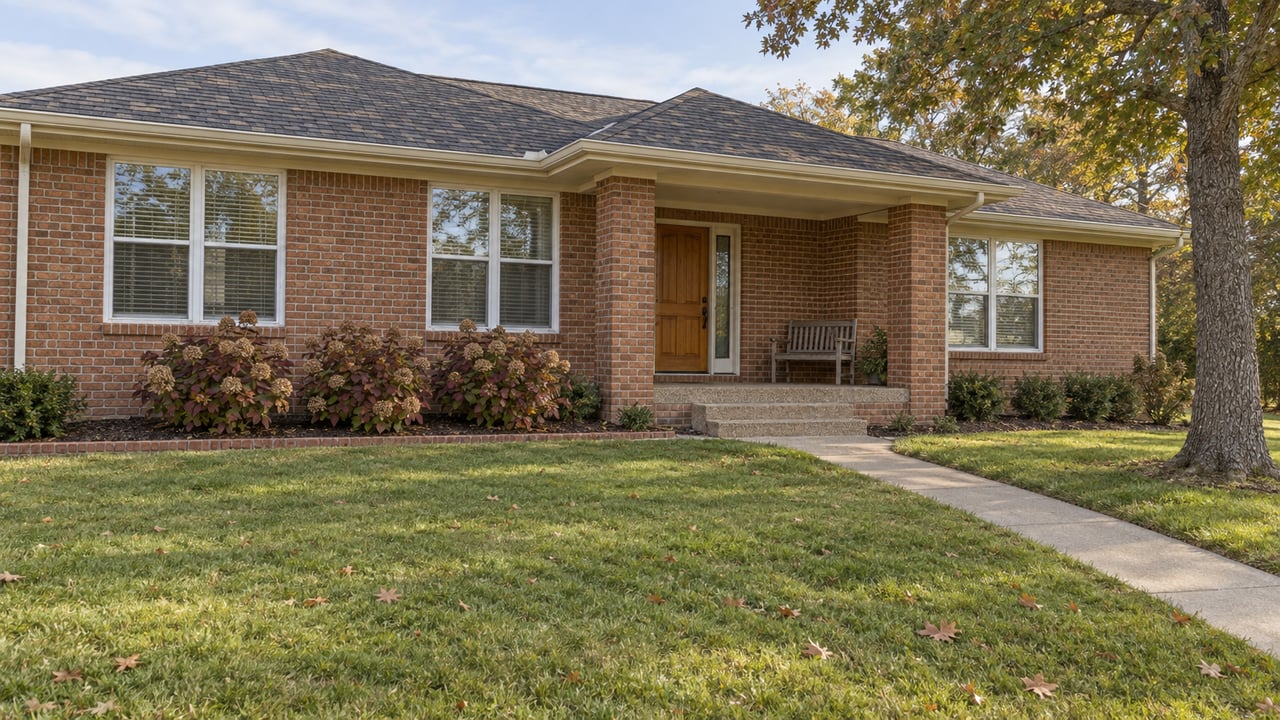
Mountain Home AR Home Prices in 2026: What Fall Trends Reveal
October 22, 2026
October 22, 2026
If you've been watching Mountain Home from a distance, you've probably seen the headline number. The median listing price in the Mountain Home area was $329,675 in September 2026. A year earlier, in September 2025, it was $293,500. That's about a 12% jump in one year. Read on its own, it sounds like a market racing away from buyers.
The homes behind that number got bigger, though. The median listed home in September 2026 had 1,931 square feet, up from 1,760 a year earlier. That's roughly 10% more house. The median asking price per square foot went from $165 to $167, an increase of about 1%. Most of the "price increase" is a change in what's for sale. And inside 2026, asking price per square foot has been falling since spring.
That changes how you should read a Mountain Home listing this fall.
All of these figures come from Realtor.com listing data, published monthly by the Federal Reserve Bank of St. Louis for the Mountain Home area on its FRED database. They're asking prices on active listings. They aren't closed sale prices, and they don't tell you what buyers actually paid at the closing table. Even so, asking prices show you how sellers are pricing, and that's the first number you'll negotiate against.
Here's how 2026 has gone month by month:
Month (2026) | Median listing price | Median square feet | Median asking price per sq ft |
|---|---|---|---|
January | $293,500 | 1,675 | $169 |
February | $296,250 | 1,757 | $171 |
March | $315,000 | 1,876 | $178 |
April | $325,000 | 1,856 | $178 |
May | $329,900 | 1,858 | $177 |
June | $327,450 | 1,888 | $172 |
July | $329,950 | 1,917 | $170 |
August | $329,900 | 1,919 | $170 |
September | $329,675 | 1,931 | $167 |
Look down the columns and you'll see two trends running in opposite directions. Asking price per square foot peaked at $178 in March and April 2026. It hasn't gone up in any month since, and by September it was down to $167. Over the same months, the median listed home kept getting bigger, from 1,856 square feet in April to 1,931 in September. Those two movements roughly cancel out, so the median price has sat near $330,000 since May.
Here's an illustration using the medians. A home the size of September 2025's typical listing, 1,760 square feet, priced at September 2026's median of $167 a foot, comes to about $294,000. That's almost exactly where the area's median asking price was a year ago. Medians from separate series don't combine perfectly, so treat this as a rough check, not a precise split between bigger homes and real appreciation. Still, it shows why the 12% headline overstates how much more the same house costs.
The trend isn't limited to one slice of the data. FRED's Baxter County series tracks almost exactly the same. Its asking price per square foot rose to $177 in March and May 2026 and was down to $166 by September, while its median listed size grew to 1,935 square feet.
An $11 drop per square foot sounds small until you multiply it out. On a home the size of September's median listing, 1,931 square feet, the gap between spring's $178 and September's $167 comes to about $21,000 in asking price for the same space.
That's why comparing a listing to "the median" can mislead you in either direction. If you're shopping a 1,700-square-foot ranch home, a $330,000 headline median makes a $290,000 asking price look like a deal. It may just be priced in line with today's per-foot rate for its size. And a larger home listed this fall at a per-foot price set back in March may be the one that's actually stretching.
The listing data shows the median size went up. It doesn't say which homes caused it. What local reporting does show is steady new residential construction in the city, some of it at permit values well above the starter-home range.
KTLO's monthly reports on Mountain Home building permits trace part of that pipeline:
A permit value isn't a listing price, and these reports don't include square footage or say whether a given home later hit the market. Some of these projects are rentals. Read them as evidence that new construction is part of today's mix. It's one likely reason the median listing looks larger, not proof of the full cause. Buyers weighing a newer build against an older home can find more on that comparison in our earlier look at new construction versus resale in Mountain Home.
If asking prices were rising on real demand, you'd expect homes to sell faster. They're selling slower. Here's the Mountain Home area for September 2026:
More homes were under contract in September 2026 than a year earlier, so buyers are still committing. But the typical active listing is sitting longer, and price cuts ticked up from August to September. That pattern fits a market where sellers set prices back near the spring peak and the market is gradually correcting them.
The drop in new listings matters for timing. Only 70 new listings came on in September, compared with 92 in August, so fewer fresh homes are competing with the ones already sitting. That cuts both ways. A buyer has fewer new choices to wait for, and a seller whose home has passed the 81-day median is now competing for the buyers who are still writing offers.
The headline median won't tell you much about a specific house. These numbers will:
Are Mountain Home home prices going up or down in 2026? Asking prices per square foot rose early in the year and then fell. In the Mountain Home area they went from $169 in January 2026 to $178 in March and April, then drifted down to $167 by September. The median asking price stayed near $330,000 from May through September because the listed homes got larger.
Do these numbers show what homes actually sold for? No. These Realtor.com series track active listings, so they reflect asking prices, inventory, and time on market. Closing prices come from recent comparable sales, which an agent can pull for a specific home.
When does the next monthly update come out? FRED listed November 5, 2026, as the next release date for these series, which will add October's figures.
Why did Mountain Home's median asking price rise 12% if price per square foot barely moved? Because the typical listed home got bigger. The median listing went from 1,760 square feet in September 2025 to 1,931 in September 2026, while the median asking price per square foot only moved from $165 to $167.
How long are Mountain Home homes taking to sell? The median listing spent 81 days on the market in September 2026, up from 71 in August and 75 a year earlier.
If you're pricing a Mountain Home home this fall, as a buyeror a seller, we'll run the per-square-foot math on the exact homes you're considering and show you how long their closest matches have been sitting. Reach out to Home With the Hoffmanns and let's work together on a number that fits the house, not the headline.
Stay up to date on the latest real estate trends.
We are a full-service team that provides a clear, stress-free process for every client. We offer specialized support for first-time homebuyers and sophisticated, strategic marketing for luxury clients, turning complex transactions into certain success.

[email protected]
(870) 404-9373
[email protected]
(870) 656-2218
707 N Cardinal Dr Ste 4
Mountain Home, AR 72654