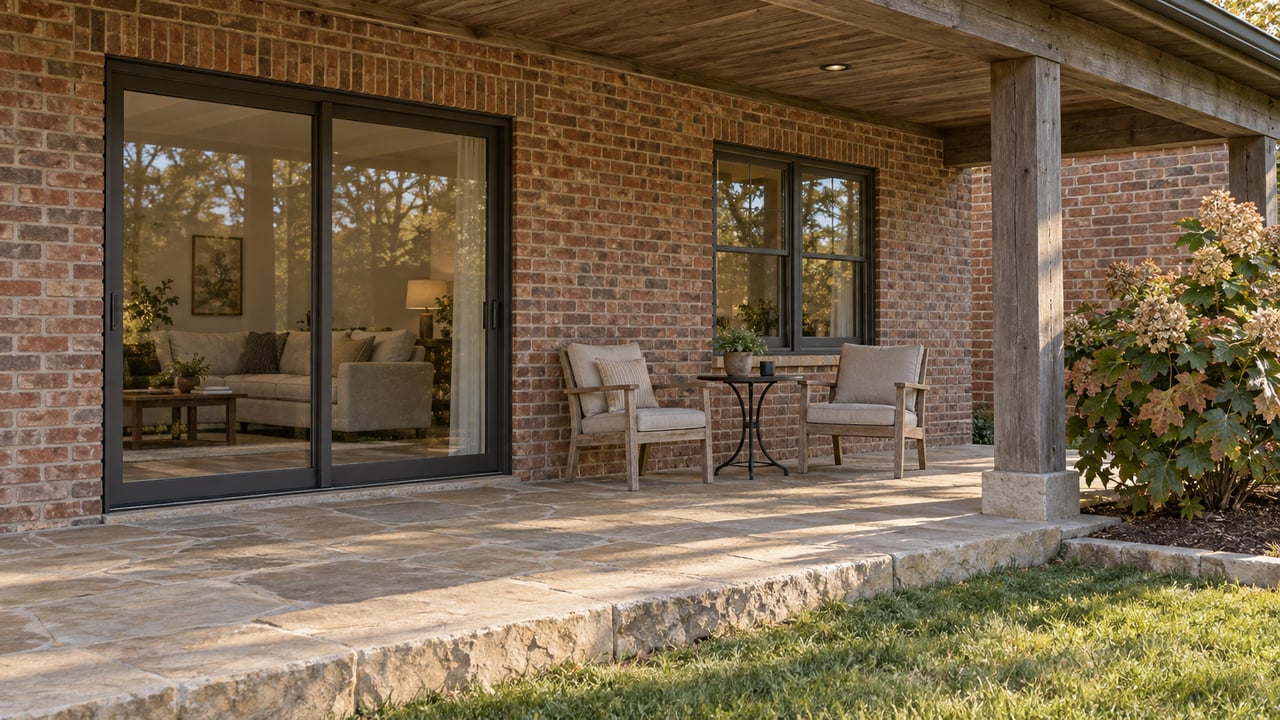
Bull Shoals Lake Private Boat Dock Permits: What Buyers Must Check
October 8, 2026
October 8, 2026
"Designation as a limited development area does not guarantee the approval of dock placement." That sentence comes from the U.S. Army Corps of Engineers' Bull Shoals Lake Shoreline Management Plan, the federal rulebook for every private dock on the lake. If you're comparing lake homes around Bull Shoals, that sentence matters more than anything printed on the listing. The plan was approved on July 16, 2018, and it's still the final version linked by the Corps' Little Rock District.
Here's how it works. Around this lake, the right to keep a dock belongs to a person who holds a permit. It doesn't belong to the house. That permit depends on a map, a measurement, and how crowded a stretch of shoreline already is. Two homes that look the same online can have very different dock prospects, and you usually find out during the transaction, not while browsing.
Start with the friction that catches buyers first. The plan says private floating facility permits "are nontransferable" and that "a new permit will be issued upon change of ownership, once all requirements are met." The Corps' shoreline page says the same thing in plainer words: when property sells, the buyer has to apply for a new permit to keep a permitted activity going.
A dock sitting in the water at closing is a good sign, but it isn't the same thing as your approval. Shoreline use permits run no longer than five years, and the District Commander can revoke them when the public interest requires it. The plan also states that a permit "does not convey real-estate or exclusive-use rights," and that owning land next to the lake doesn't give you exclusive use of the Corps land or water beside it.
The Corps tells prospective buyers of property bordering the government strip to check with the Mountain Home Project Office before they buy. That advice holds even when a dock is already there, because the questions the office will ask the next owner are the same ones that decided whether the dock could be built in the first place.
The Corps sorts the lake's shoreline into allocations. Limited Development Areas are where docks may be permitted. Public Recreation Areas restrict permits. Protected Shoreline Areas allow no docks or shoreline use permits. Prohibited Access Areas bar private docks for safety and security reasons. The final plan also mentions Restricted Limited Development Areas, so you have to look up a lot's mapped designation. You can't assume it from the word "lakefront."
The plan defines legal access to a Limited Development Area two ways. You can own adjacent private property within 200 feet of the proposed dock, or the dock can sit within 200 linear feet of a government-designated parking area next to the zone. Perpetual access easements "will not be recognized as legal access for new dock placement." That last rule is a big one for lots set back from the water with a deeded path to the shore. The easement can still get you to the water on foot, but it won't support a new dock.
This is the question most buyers never think to ask, and it's where the economics show up. The next section walks through it.
The plan's spacing rules are strict. Docks must be at least 100 feet apart at the 659-foot conservation pool. They can't reach more than one-third of the way across a cove. And docks in a Limited Development Area can't take up more than 50 percent of that zone's total shoreline.
Density uses a published formula. Take the number of docks minus one, multiply by 100 feet of safety spacing, and add the combined width of the existing docks. The total has to stay at or below half the zone's official length.
Here's what that formula does to a made-up 1,000-foot zone where every dock is 30 feet wide. These are illustration numbers, not a real stretch of shoreline:
| Docks in zone | Spacing allowance | Dock widths | Density total | Limit of 500 ft |
|---|---|---|---|---|
| 3 | 200 ft | 90 ft | 290 ft | Under |
| 4 | 300 ft | 120 ft | 420 ft | Under |
| 5 | 400 ft | 150 ft | 550 ft | Over |
In this example, a thousand feet of shoreline holds four docks, and the spacing allowance takes up far more of the limit than the docks themselves. Once a zone hits that ceiling, the plan says the public and dock owners in the area should be notified "that no additional facilities will be allowed," and zones already over the limit get brought back down through attrition.
When the plan was written, 32 percent of existing Limited Development Areas had already reached maximum density. The Corps keeps those areas in a GIS map that you can view at the Mountain Home Project Office. That figure dates to 2018. The plan calls maximum density "a fluid status that changes as docks are added to or removed from the LDA," so today's map is the only answer for any specific lot.
This is the part that matters for price. A home in a full zone that already has a permitted dock holds something the zone can't hand out again. A home with no dock in that same zone can't get one until somebody else's dock comes out. On a listing, both show up as lake homes.
A lot can pass on zoning, access, and density and still run into terrain. A new or relocated floating dock needs at least eight feet of water measured 60 feet straight out from shore at the 659-foot pool. Building new steps, stairs, or other improved access to reach it isn't allowed. The Operations Project Manager can deny a site with a severe slope, unsafe terrain, or bluffs.
The application needs professional engineer stamped plans for the whole structure, with written approval before construction starts. Each new stall requires a current boat registration, and boats can't be longer than 28 feet or longer than the stall. The plan lists a $30 permit application fee. If your plans include a bigger boat, that 28-foot cap is worth checking before the inspection period starts.
The Corps manages about 56,413 acres around Bull Shoals Lake, and the line between public and private land is irregular. It isn't a set distance from the water. Survey monuments define that line. Witness posts and painted trees don't. When the exact line matters, the plan recommends hiring a licensed surveyor at the adjacent owner's expense.
That strip has its own rules, and they affect how a lake home looks and works:
So the open, mowed view down to the water in listing photos is something the Corps controls. The new owner doesn't get to decide it alone.
The office that answers all of these questions has had capacity problems. On May 12, 2025, the Little Rock District cut Mountain Home Project Office hours to Tuesdays and Fridays and put "a temporary moratorium for Shoreline Use Permit requests, including dock and vegetative management permits," in place until Oct. 1, 2025. The same release said the reduced services would last "until staffing levels improve." The Corps' Bull Shoals Lake page now lists Monday through Friday, 8 a.m. to 4:30 p.m. As of early October 2026, we haven't found a public notice confirming current permit intake, so call the office directly before you set your contract timelines.
Water levels matter too. On June 22, 2026, the Corps closed swim beaches at Lakeview, Oakland, and Theodosia because of high water and debris. The plan warns that during high water events, getting to a dock from shore may not be possible.
If the answers rule out a private dock, a marina slip is the usual fallback. Lakeview Cove Marina offers overnight and annual slips, with overnight rates listed from $27 a night. Oakland Marina lists covered slips with 20-amp power for annual or daily rental. Sugarloaf Harbor Marina lists annual slips, with 30 to 50 amps for houseboat slips. In town, Bull Shoals Lake Boat Dock offers boat rentals and lodging.
Can I add a dock later if the house doesn't come with one? Only if the lot is in a Limited Development Area, meets the access test, has room under the density limit, and passes the depth and slope requirements. Even then, approval isn't guaranteed.
Who do I contact? The Mountain Home Project Office, which the Corps' current Bull Shoals Lake page lists at 324 Natural Resources Drive, Mountain Home, phone (870) 425-2700.
Does a mooring buoy follow the same rules? Buoys get their own five-year permit, which the plan lists at $30, and they're inspected every year.
If you're looking at a lake home around Bull Shoals and want to know where its dock stands before you make an offer, Costin Hoffmann and Alex can help you work through these questions with the Corps early, so the dock you're counting on is still part of the plan at closing. Let's Work Together.
This article is general information, not legal, tax or financial advice. Consult a qualified professional about your situation.
Stay up to date on the latest real estate trends.

We are a full-service team that provides a clear, stress-free process for every client. We offer specialized support for first-time homebuyers and sophisticated, strategic marketing for luxury clients, turning complex transactions into certain success.

[email protected]
(870) 404-9373
[email protected]
(870) 656-2218
707 N Cardinal Dr Ste 4
Mountain Home, AR 72654